

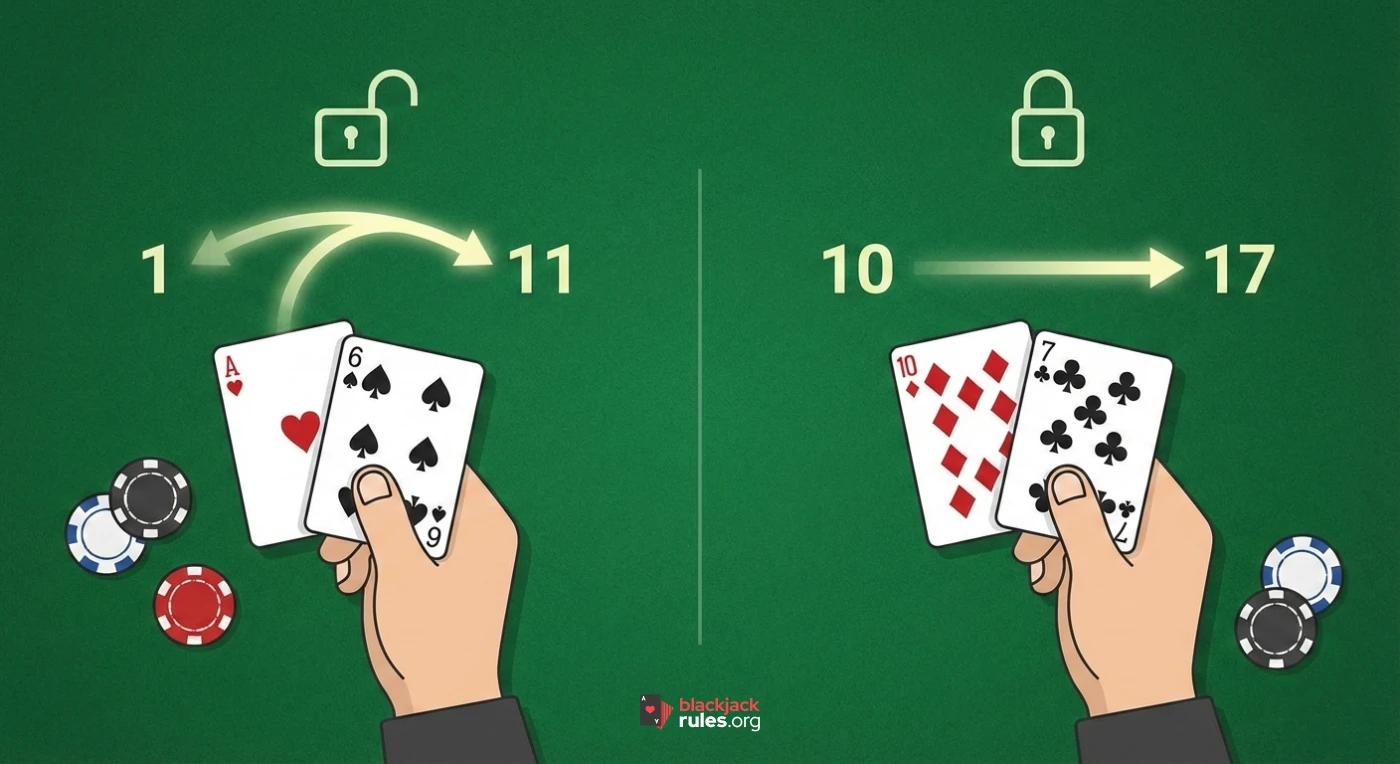
In blackjack, the terms soft hand and hard hand describe whether your hand includes an Ace that can safely be counted as 11 without busting. Understanding the difference is a big deal because it changes the correct play (hit, stand, double) in many situations.
Quick Definitions
- Soft hand – A hand with an Ace counted as 11. Because the Ace can also become 1, you have flexibility and can’t bust with one hit in many cases.
- Hard hand – A hand with no Ace, or a hand where any Ace must be counted as 1 to avoid busting.
Soft Hand Examples (Easy)
A soft hand happens when counting the Ace as 11 keeps the total at 21 or less.
- A + 6 = soft 17 (often written as A,6)
- A + 2 + 4 = soft 17 (Ace still counts as 11)
- A + 7 = soft 18
- A + 3 + 5 = soft 19
Why it’s “soft”: You can draw a big card and the Ace can “soften” the hand by switching from 11 to 1.
Example: You have A,6 (soft 17). If you hit and draw a 10, you don’t bust. Your Ace becomes 1 and your hand becomes 17 (hard 17).
Hard Hand Examples (Easy)
A hard hand is either:
- A hand with no Ace, or
- A hand where the Ace must count as 1 (otherwise you’d bust)
- 10 + 6 = hard 16
- 9 + 7 = hard 16
- A + 6 + 10 = hard 17 (the Ace must be 1 here)
- A + 9 + 9 = hard 19 (Ace must be 1)
How to Tell if a Hand Is Soft (Fast Rule)
Ask this question:
“Can I count an Ace as 11 without going over 21?”
- If yes – it’s a soft hand
- If no – it’s a hard hand
Why Soft vs Hard Matters for Strategy
Soft hands are usually more aggressive hands because you have built-in protection against busting. That’s why basic strategy often tells you to:
- Hit certain soft totals that you would stand on if they were hard
- Double down more often with soft hands (especially soft 13 through soft 18) against certain dealer upcards
Example:
Many players stand too often on soft 17 (A,6) because “17 is okay.” But soft 17 is not the same as hard 17 – you can often improve it safely, and in many rule sets it’s a common double or hit depending on the dealer’s upcard.
Common Mistakes Players Make
1) Treating Soft 17 Like Hard 17
Soft 17 (A,6) has flexibility. If you stand automatically, you may be giving up good chances to improve or double in the right spots.
2) Forgetting a Soft Hand Can Become Hard
A hand can change mid-round. Example:
- You start with A,5 (soft 16)
- You hit and draw a 9
- Now you have A,5,9 = 15 (hard 15) because the Ace must count as 1
Some players keep thinking “I have an Ace so it’s soft,” but that’s not always true.
3) Misreading Multiple Aces
More than one Ace can still be soft – but only one Ace can be 11 at a time.
- A + A = 12 (soft 12) because it’s 11 + 1
- A + A + 9 = 21 (still works as 11 + 1 + 9)
- A + A + 9 + 5 = 16 (hard 16) (all Aces must be 1 now)
4) Standing on Soft 18 No Matter What
Soft 18 (A,7) is strong, but it isn’t always an automatic stand. Depending on the dealer’s upcard and the table rules, it can be a hit or double in some situations.
Bottom Line
A soft hand includes an Ace that can count as 11 without busting, giving you flexibility. A hard hand either has no Ace, or any Ace must count as 1. Knowing the difference helps you avoid the most common strategy mistakes – especially on hands like A,6 and A,7.